.svg)

.svg)
.svg)

.svg)



.png)




 Crosschq Blog
AI won’t replace recruiters. But recruiters who use AI will replace those who don’t.

One of my favorite things about working in this industry is that every few years, a new technology arrives and the discourse immediately jumps to the most dramatic possible conclusion.
Yeah, but this time it’s different, Fitz.
Is it?
Look, I don’t want to dismiss anyone’s preoccupations about AI, because there’s some very real and very serious stakes. AI is absolutely changing recruiting (and the world), meaningfully and fast. But all the discourse around AI “replacement” is played out, and it gets this whole thing backwards.
The recruiters I see struggling aren’t the ones being displaced by AI.
They’re the ones trying to do a 21st-century job with 20th-century tools, drowning in volume, making gut-call decisions under time pressure, and then wondering why quality of hire feels like a coin flip.
This whole AI gambit isn’t to fix recruiting by removing humans from the process. It’s to fix recruiting by making the humans in the process dramatically more effective. That’s a meaningful difference. It puts the onus on vendors to design technology with humans in mind (including candidates), but it also means that resistant recruiting teams who have been slow to adapt need to catch up.
Fast.
Because the world of TA is changing whether they like it or not. And that new world is going to need more great recruiters.
The problem AI actually solves.
Let’s be honest about where the current process breaks down, because AI is only useful if it’s solving a real problem.
- The volume problem is obvious: recruiters are managing more candidates than any human being can thoughtfully evaluate. When you’re reviewing 200 applications for a single role, the cognitive math doesn’t work. Something gets shortchanged — and it’s usually the candidates who don’t look like the last person who succeeded in the role, who didn’t go to the right school, or whose resume formatting triggered an ATS filter designed in 2009.
- The consistency problem is less talked about, but arguably more damaging. When ten different recruiters evaluate candidates using ten slightly different mental models, you don’t get ten perspectives — you get ten sources of unstructured bias. Research consistently shows that unstructured interviews have a predictive validity barely above chance. We are, in many cases, quite literally guessing. And we’re guessing differently depending on who’s doing the guessing.
- Then there’s the data problem. Most recruiting teams make high-stakes decisions with remarkably thin information. A resume, a phone screen, a handful of interviews. And crucially, as we covered in a previous article, almost none of the post-hire performance data ever makes it back upstream to inform future decisions. It’s a closed loop that was never closed.
AI, done right, addresses all three. Not by replacing human judgment, but by making human judgment better informed, more consistent, and more defensible.
What ‘better information’ actually looks like.
At Crosschq, we’ve spent a lot of time thinking about what it means to give recruiters genuinely better information — not just more data, but signal that actually predicts whether someone will succeed in a role.
Take reference checking. It’s one of the most universally acknowledged steps in the hiring process and one of the most universally phoned-in. A recruiter calls two references, gets two glowing endorsements from people the candidate personally selected, and files it away as a box checked.
Everyone knows this. Nobody has fixed it.
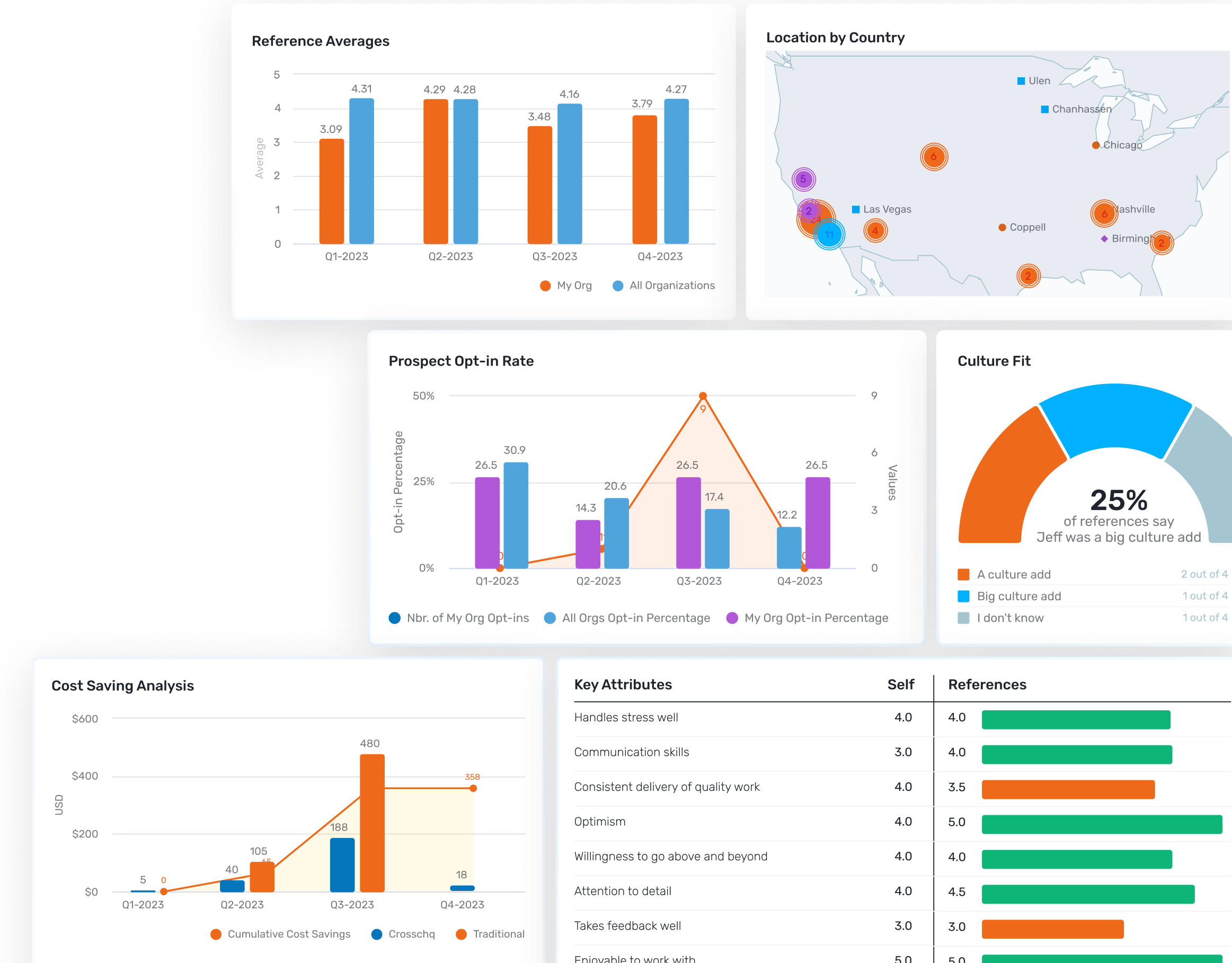
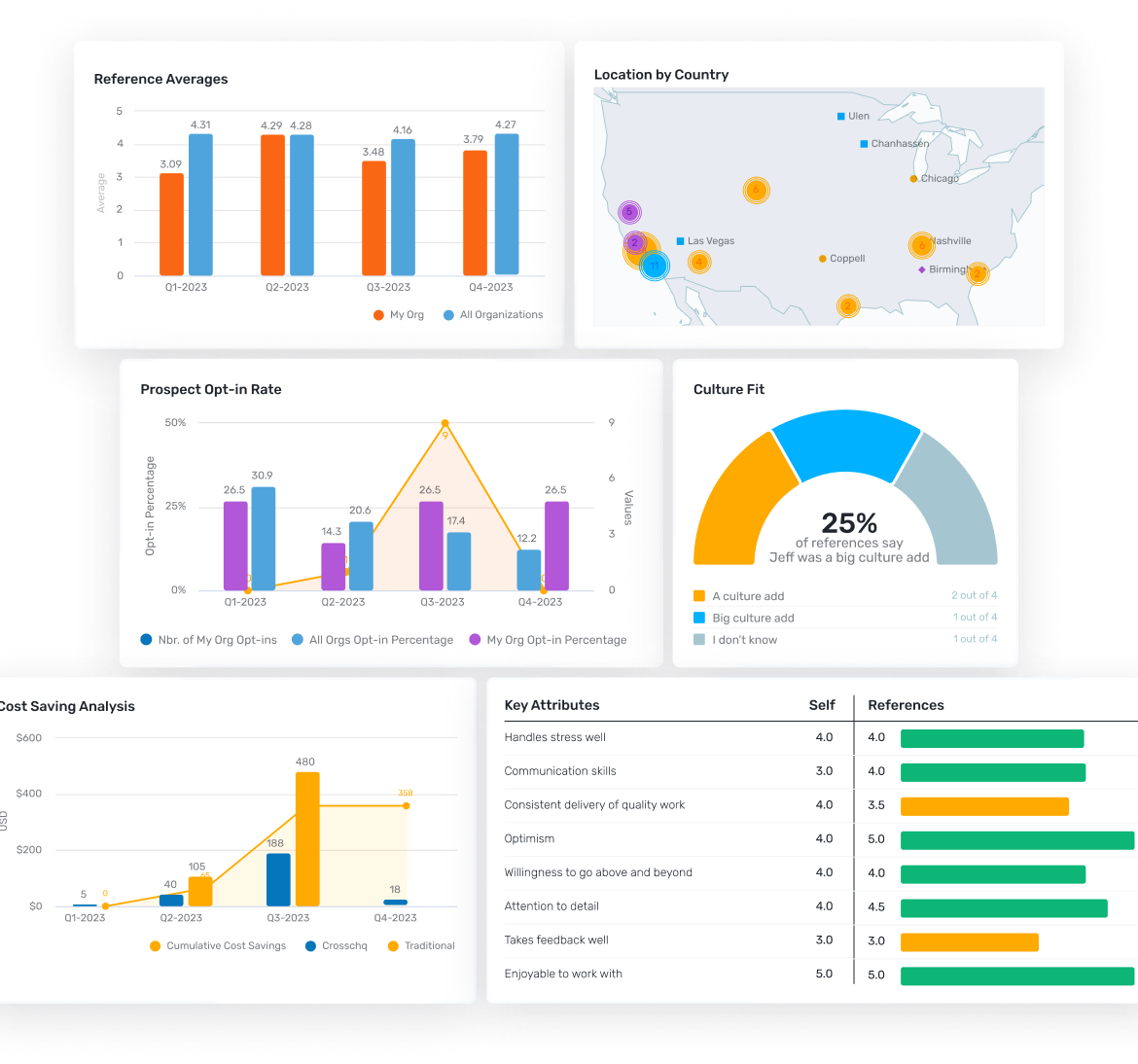
Crosschq’s approach structures the reference process in a way that changes the quality of information entirely. Instead of a casual conversation between two people who both want things to go smoothly, you get structured, consistent feedback collected at scale (across multiple references), measured against role-relevant dimensions, and benchmarked against what high performers in similar roles actually look like. The data becomes meaningful. It starts to predict things.
The same logic applies to AI-powered interviewing. The value isn’t in removing the human interviewer — it’s in ensuring that every candidate gets asked the same questions, evaluated against the same criteria, and scored in a way that can be compared across the candidate pool. Consistency is the ingredient most interview processes are missing. When you introduce it, you get something that actually functions as a fair evaluation rather than a vibe check dressed up in professional clothing.
And now, with the addition of personality and work-style assessments through our Traitify acquisition, we’re able to bring another critical layer into the picture: not just whether someone can do the job, but whether the job is genuinely right for them. That’s a subtle but important distinction. A candidate might have all the technical skills for a role and still fail because the environment, the pace, or the collaboration style is a fundamental mismatch for how they’re wired.
Assessments done right surface that early, before anyone has wasted time, including the candidate.
The candidate experience angle nobody talks about.
Here’s something the “AI is dehumanizing hiring” crowd consistently misses: the status quo is already pretty dehumanizing for candidates.
Think about what the current experience looks like from the other side of the process. You apply for a job. You wait. You get a form rejection three weeks later, or nothing at all. If you do get an interview, the questions are inconsistent and the criteria are opaque. You have no idea what’s being evaluated or how. The whole thing feels arbitrary — because it is.
AI-structured processes, counterintuitively, can make this more human. When every candidate goes through the same structured interview, gets asked the same thoughtful questions, and is evaluated against the same criteria, that’s not cold. That’s just fair. When reference data is collected in a way that gives context to a candidate’s experience rather than just confirming they once held the job title, that’s actually enlightening. When an assessment helps a recruiter understand that a candidate would thrive in an autonomous, fast-moving environment — and the role on offer is exactly that — both parties win.
The most human outcome in hiring isn’t a warm conversation that leads to a bad decision. It’s helping candidates find roles where they’ll genuinely succeed and be happy — and helping recruiters make decisions they can stand behind.
AI, used correctly, gets you closer to that outcome.
What recruiters actually gain through using AI.
The teams that will get the most out of AI tools are the ones that understand true empowerment means letting certain things go.
Great recruiters of today and tomorrow will not cling to phone screening or resume reviewing or reference checking as essential parts of the job.
They’ll let AI handle it. And they’ll go spend their time on things that actually matter.
When a recruiter has structured reference data, AI interview scoring, and work-style insights sitting in front of them before they make a recommendation, they’re not being replaced. They’re being equipped. They can have a richer conversation with the hiring manager. They can advocate for a non-obvious candidate with evidence rather than instinct. They can explain a recommendation in terms that go beyond “I just had a good feeling about them.”
That’s what the best recruiting looks like: informed, consistent, defensible, and genuinely focused on finding the right fit rather than the fastest close. AI makes it possible for more recruiters to operate at that level.
And frankly, it frees them up. When AI is handling the parts of the process that shouldn’t require human judgment (volume triage, scheduling, structured scoring) recruiters get their time back for the parts that do (building relationships, understanding the nuances of a role, coaching hiring managers, and thinking strategically about where talent is going to come from six months from now)
That’s the work most recruiters got into this field to do. And it’s why we create products, too.
Now, none of this is an argument for deploying AI tools uncritically. The same consistency that makes AI valuable can also make it consistently wrong if it’s trained on biased data or applied without oversight. Algorithms don’t have values, they have objectives. And if the objective is poorly defined, you can automate your way to worse outcomes at remarkable speed.
This is why we think about AI in recruiting as augmentation, not automation. The tools surface better information. The humans make the calls. The data gets reviewed for patterns that might indicate bias. The feedback loop stays open. Done that way, AI improves efficiency and fairness. It reduces the influence of gut feel and unchecked intuition, which is where most hiring bias actually lives.
The ultimate goal of what doomsayers call “AI replacement” is actually a process that’s better for candidates, better for recruiters, and better for the organizations trying to build great teams. And our goal as a company isn’t to create technology for the sake of creating technology. It’s to help people do better people stuff.
So help us help you and embrace the change. Your organization’s and your candidates will thank you.
.jpg)
Take the Guesswork
Out of Hiring
Schedule a demo now