.svg)

.svg)
.svg)

.svg)

.png)




 Crosschq Blog
.jpg)
Skills tell you what someone has done. References tell you how they did it. Assessments tell you who they are. We’ve been building toward this for a long time.
I want to tell you more about a decision we’ve been building toward for years, and why I think it’s one of the most important things we’ve done as a company.
Recently, Crosschq announced the acquisition of Traitify, a leading behavioral assessment platform. And while there was plenty of good information in the press release and social posts we put out, this one requires a little more depth — because the reasoning tells you a lot about where we believe hiring is going, and why we think the industry has been missing something fundamental.
We’ve always believed that great hiring is a data problem. The more accurate, structured, and predictive your pre-hire data, the better your post-hire outcomes. That’s the thesis Crosschq was built on. What Traitify gives us is the layer of that data picture we’ve never been able to paint before.
And it’s going to take us to exactly where we always wanted to go: a place where measuring and predicting quality of hire is a commonality, not a pipe dream.
What we’ve built, and what was still missing.
Crosschq started with reference checking. And specifically, with the conviction that reference data, collected the right way, is one of the most underutilized predictive signals in all of hiring. When you structure it, scale it, and benchmark it against high performers in similar roles, it stops being a formality and starts being genuinely useful intelligence.
More recently, we expanded into AI-led interviewing and hiring intelligence — bringing the same logic to the interview stage. Consistency, structure, and scoring that can actually be compared across candidates and over time.
Less gut feel, more signal.
Together, those two capabilities answer two important questions: How has this person performed in the past? And how do they present and communicate in a structured evaluation? Those are valuable questions. But they’re not the whole picture.
The question we couldn’t answer well — the one that sits behind a significant portion of poor hires — is this: Is this role genuinely right for this person?
Not just on paper. Not just based on what they’ve done before.
But in terms of how they’re wired, how they work, what kind of environment brings out their best, and where they’re likely to struggle. That’s the missing layer. And it’s the one that Traitify was built to fill.
Why this layer matters more than most teams realize.
Here’s a data point I keep coming back to: SHRM research shows that 89% of hiring failures are attributable to attitudinal issues and poor cultural or role fit, not skill gaps.
Let that sink in for a moment.
Nearly nine out of ten bad hires weren’t bad because the person lacked the technical ability to do the job. They were bad because something about the fit was wrong.
The unfortunate news is that we — the tech builders and practitioners who have powered and championed these failed processes for decades — are complicit in digging this neck-high hole. The good news is that we now have the tools to dig ourselves out.
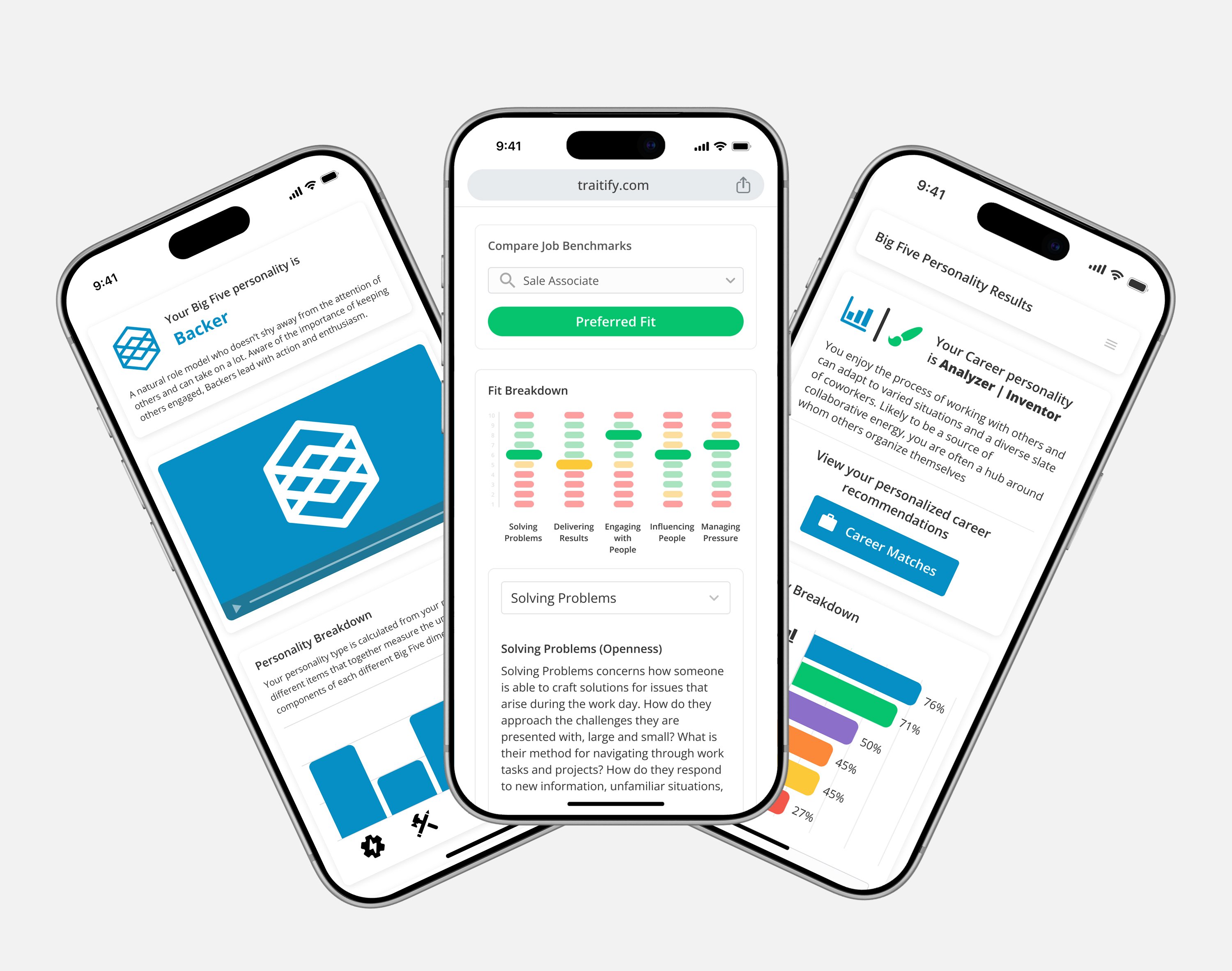
Effective behavioral assessments give you structured, validated, role-relevant data about how a person actually operates. The best assessments aren’t designed to trip people up or sort them into rigid buckets, they’re designed to surface genuine patterns: how someone processes information, how they collaborate, how they handle ambiguity, where they find energy, and where they find friction.
That information is genuinely predictive. And it’s the kind of predictive that compounds, because once you start correlating assessment profiles with actual post-hire performance, you build a feedback loop that makes every future hire smarter than the last.
Why Traitify.
There are a lot of assessment tools in the market. Many of them are long, tedious, and designed in a way that feels more like a compliance exercise than a useful evaluation. Candidates sit through forty-five minutes of forced-choice questions and come out the other side feeling like they just filled out a tax form.
Traitify was built differently.
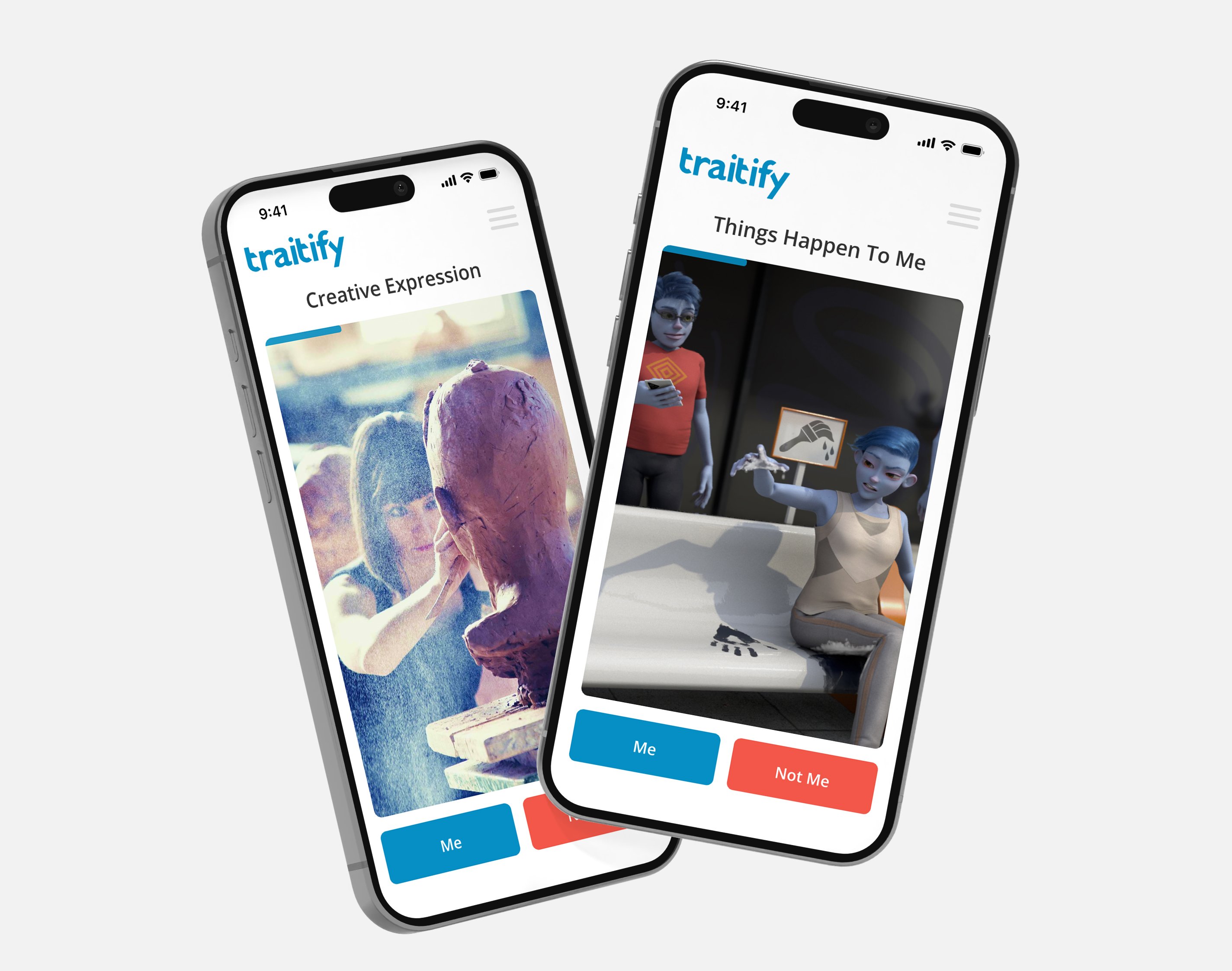
It’s fast — most assessments take a few minutes to complete — and it’s visual and engaging in a way that actually improves completion rates and reduces the cognitive load that introduces noise into the results. It’s mobile-first, which matters enormously for reaching hourly workers, frontline roles, and candidates who aren’t sitting at a desk. And critically, it’s grounded in the Big Five personality framework, which is the most scientifically validated model in all of personality psychology.
This isn’t astrology dressed up as HR tech. The science is real, the methodology is rigorous, and the results are interpretable in ways that directly connect to job performance.
But the reason we acquired Traitify specifically isn’t just the product — it’s the integration opportunity. Traitify’s assessment data sitting in isolation is useful. Traitify’s assessment data layered on top of structured reference insights and AI interview scoring is something categorically more powerful. Layer in our pioneering quality of hire measurement and this is something truly unprecedented.
It’s the difference between having a few pieces of a puzzle and being able to see the whole picture.
Imagine a hiring process where, before a single interview takes place, you have structured reference data telling you how this person has actually performed and been perceived by people who’ve worked alongside them. You have a validated personality and work-style assessment telling you how they’re wired and whether that profile matches the patterns of high performers in this specific role. And you have an AI-assisted interview framework that’s been sharpened by both of those data sources — so your interviewers are asking the right questions and probing the right areas, rather than winging it.
By the time you make a hiring decision, you’re not going on gut feel. You’re going on a convergence of structured, validated signals that together tell a coherent story about whether this person is likely to succeed.
And then — this is the part that I think separates what we’re building from anything else in the market — that same data becomes the foundation of your feedback loop. Post-hire performance data flows back into the system. Over time, you learn which assessment profiles actually correlate with success in your specific roles, at your specific company. Your model gets more accurate. Your quality of hire improves continuously, not just at the point of implementation.
You’re turning a guessing game into a science.
That’s our vision. That’s our product roadmap.
Solving quality of hire isn’t a matter of if anymore. It’s when. And it’s soon.
The Traitify acquisition is the clearest signal yet of what Crosschq is becoming: a predictive quality of hire platform.
Not a reference checking tool that also does interviews.
Not an ATS add-on with some analytics.
A purpose-built system for connecting pre-hire data to post-hire outcomes — scientifically validated, continuously improving, and designed to make quality of hire measurable and improvable for every organization that uses it.
We believe the industry is moving in this direction whether or not any single company leads it there. The economics of bad hiring are too painful, the tools are too available, and the demand from talent leaders for something more defensible than gut feel is too loud to ignore. Predictive, assessment-based hiring isn’t a niche idea. It’s where this whole space is heading.
We intend to be the company that gets there first.
And gets it right.
So you can start doing the same with every, single one of your hires.
.jpg)
by Mike Fitzsimmons, CEO
Related Topics
Take the Guesswork
Out of Hiring
Schedule a demo now