.svg)

.svg)
.svg)

.svg)



.png)




 Crosschq Blog
Recruiting Tools That Focus on Quality of Hire: A Buyer's Guide

If you've ever sat through a recruiting tech vendor pitch, you already know the script.
Every tool claims to improve quality of hire. Every demo includes the phrase. Every deck has a slide for it.
And then you buy something, plug it in, and a year later your retention numbers look about the same.
That's the gap between recruiting tools and recruiting tools that focus on quality of hire — and the difference is real, even if it gets steamrolled by marketing copy. A tool that focuses on quality of hire is one that produces a structured, post-hire–validated signal that changes how decisions get made. A tool that doesn't is one that makes the recruiting process faster, prettier, or cheaper, without moving the actual hiring outcome.
Most of the recruiting stack is the second kind. The teams that are pulling ahead on quality of hire are getting deliberate about the first kind.
This is a buyer's guide for that work. Seven categories of recruiting tools that focus on quality of hire, what each one actually does for the metric, the evaluation criteria that separate the useful from the cosmetic, and how to layer the stack so the parts compound.
What makes a recruiting tool "focused" on quality of hire.
Two characteristics, both worth being strict about.
It produces a structured signal. Not an opinion, not a vibe — a comparable measurement that means the same thing across every candidate. Tools that add another layer of unstructured human judgment to the process generally don't move quality of hire. Tools that add structure to a place where it's currently missing usually do.
It connects to post-hire outcomes. A signal that can't be correlated with how someone actually performed in the role is a signal that can't be improved. Quality-of-hire–focused tools either capture post-hire data directly or feed pre-hire data into a system that does. If a vendor can't tell you how their output ties back to performance, retention, or in-role outcomes, the tool is probably about something else.
Apply those two filters and the field of "recruiting tools that focus on quality of hire" gets a lot smaller — and a lot more useful.
Category 1 — Structured reference intelligence.
What it does: turns one of the most universally underused steps in hiring into one of its most predictive.
Reference checking is a step almost every process touches, and almost no process does well. A recruiter calls two candidate-supplied contacts, gets two glowing endorsements from people who want things to go smoothly, and files the result away as a box checked. The signal value is roughly zero.
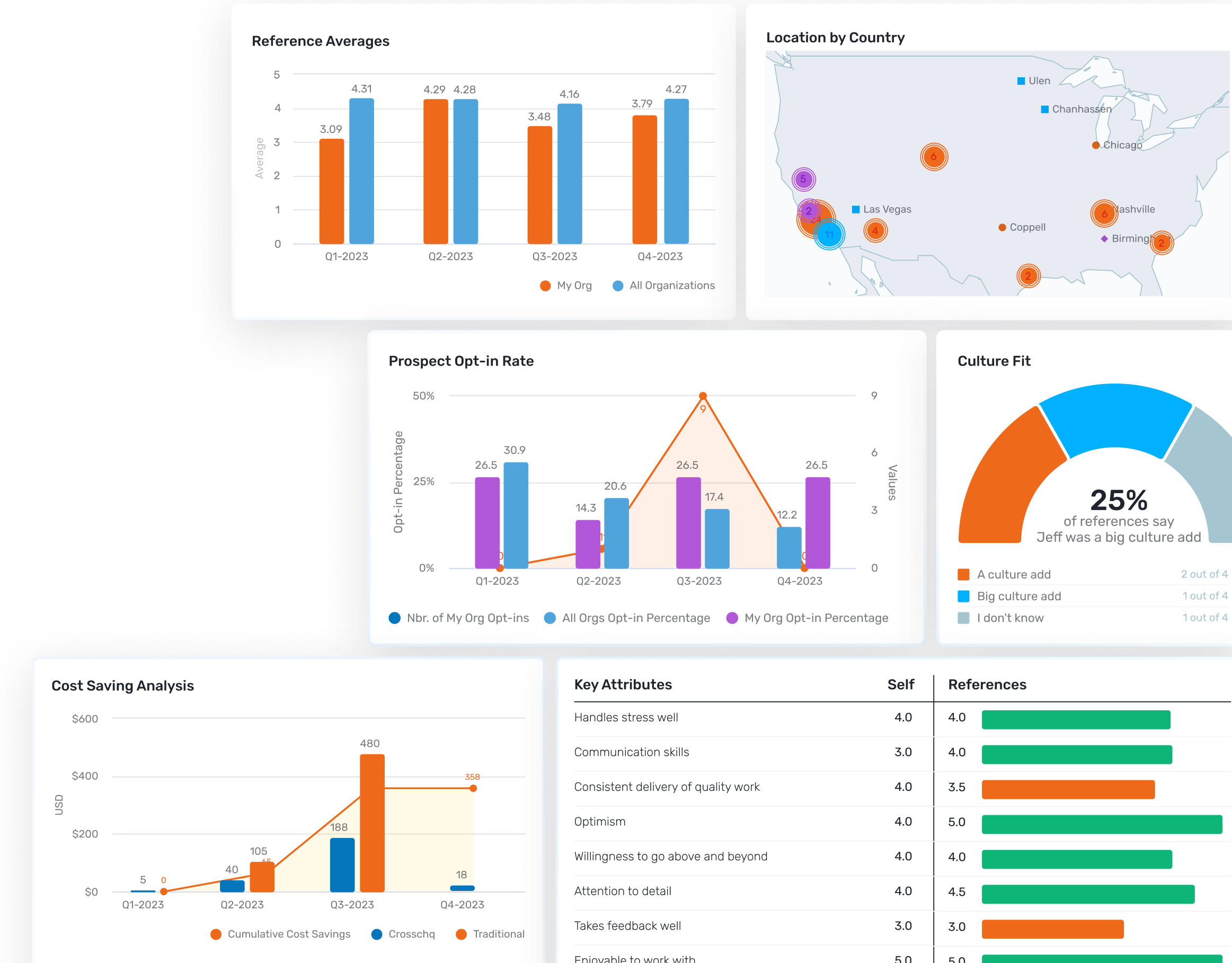
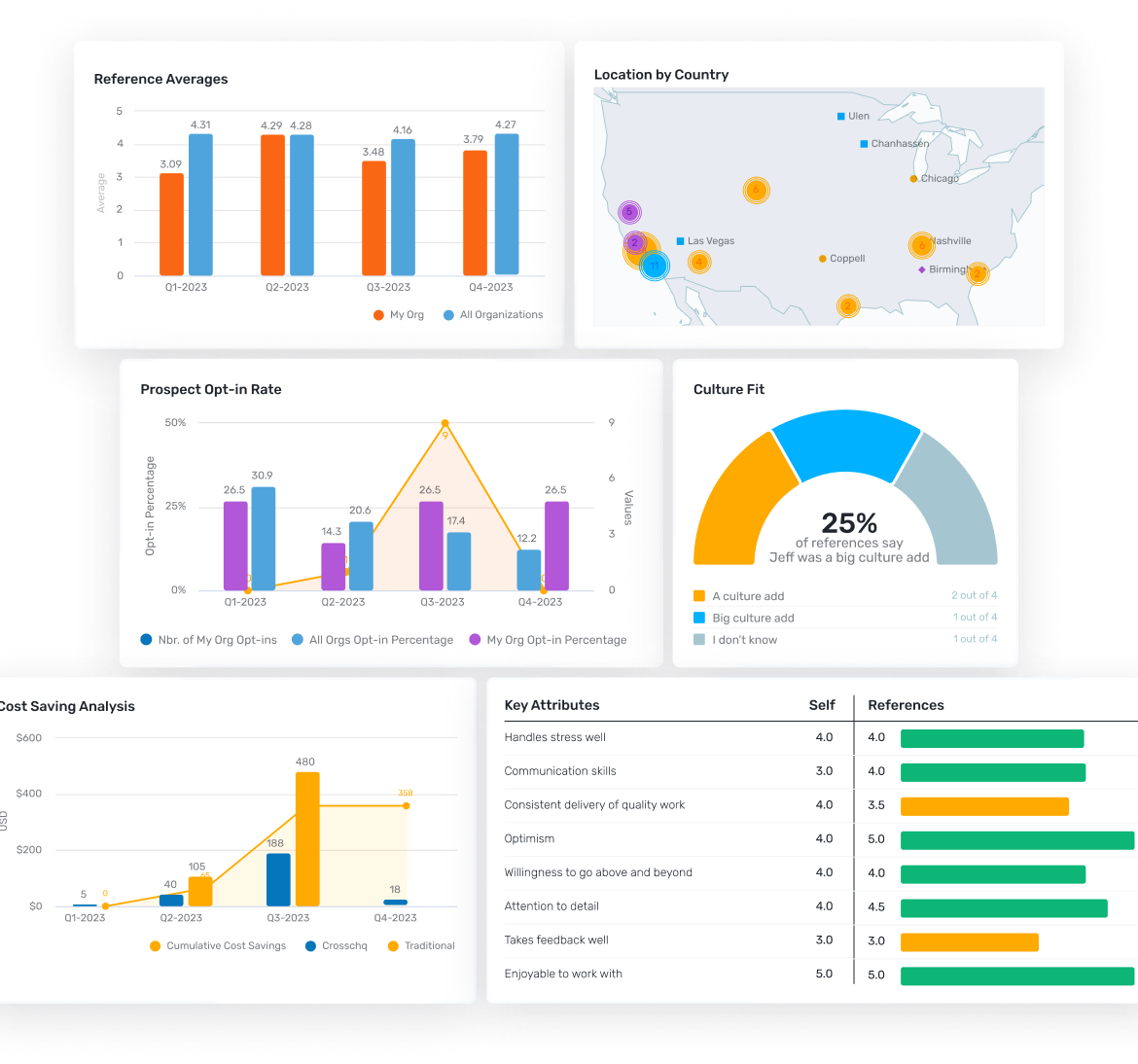
The category of tools focused on quality of hire in this space does four things differently:
- Collects from more references than the candidate would have picked (typically five to seven, including peers and direct reports).
- Asks the same structured, role-calibrated questions across every candidate for a given role.
- Captures answers on a comparable scale, not just free text.
- Benchmarks responses against high performers in similar roles, so a 4-out-of-5 means something specific.
Evaluation criteria: How many references does the tool collect by default? Are the questions role-calibrated? Is response data scored or just transcribed? How does the platform benchmark a candidate against high performers? Can the data be exported and tied back to post-hire outcomes?
Crosschq's 360 Reference Checks is the product category we pioneered, and it's a good reference point for what to expect — but the criteria above apply to any vendor in the category.
Category 2 — Structured and AI-assisted interviewing.
What it does: makes the most variable part of most hiring processes comparable, candidate-to-candidate.
This is the single highest-leverage category in the entire stack. The research is unambiguous: a 2022 re-analysis by Paul Sackett and colleagues at the University of Minnesota found that structured interviews have overtaken general cognitive ability as the strongest predictor of job performance. And yet most interview processes are still largely unstructured — different questions, different scoring, different interpretations of the same answer.
Two flavors of tool live in this category, and they solve different parts of the problem:
- Interview intelligence platforms add structure to live interviewer-led conversations — same questions, same rubric, scored independently, aggregated automatically.
- AI-assisted interviewing automates the high-volume top of the funnel (often the phone screen) so every candidate gets evaluated against the same criteria, even when volume makes that impossible for a human team.
Evaluation criteria: Does the tool enforce structured rubrics, or just record what was said? Are interviewers scoring independently before consensus, or after? Does the platform redact identifying information before scoring? Are scores reviewable and overridable by the hiring manager? Does the AI version use multiple independent models to cross-check outputs?
Interview IQ covers the structured-rubric side. The AI Interview Agent covers the volume side. Look for both capabilities in any tool claiming this category.
Category 3 — Validated behavioral and cognitive assessments.
What it does: surfaces fit and work-style signals that interviews systematically miss.
SHRM research has consistently found that the majority of new-hire failures trace back to attitudinal issues and misaligned fit, not skill gaps. Most hiring processes screen hardest on the dimension that accounts for the smallest share of failures, and most lightly on the dimension that accounts for the largest. Assessments, used correctly, close that gap.
The category contains real assessments and astrology-dressed-as-HR-tech in roughly equal measure. The split between them comes down to two questions:
- Is the science real? Look for assessments grounded in the Big Five personality framework — the most validated model in personality psychology — or in role-specific cognitive constructs (visual-spatial processing, decision-making under time pressure) for roles where those matter. Published validation studies are non-negotiable.
- Is the candidate experience tight? Long, repetitive, forced-choice assessments produce noisy data because tired candidates stop trying. Best-in-class assessments take a few minutes, are mobile-first, and feel like guided self-reflection rather than a compliance exercise.
Evaluation criteria: What scientific framework is the assessment built on? What published validity studies support it? How long does a candidate take to complete it? Is it mobile-first? How does the output integrate with the rest of the hiring stack — or does it sit in isolation?
Traitify assessments — now part of the Crosschq platform — is built on both of those principles.
Category 4 — Quality of hire analytics.
What it does: composes pre-hire signals and post-hire outcomes into a single, comparable measurement.
This is the category most recruiting stacks are missing entirely. Teams often have decent reference data, decent interview data, decent assessment data — and no system that ties any of it back to whether the resulting hire actually performed. The data is collected and then forgotten.
A real quality-of-hire analytics tool does three things:
- Captures structured post-hire performance, retention, and contribution data on a fixed cadence (typically 90, 180, and 365 days).
- Ties each post-hire outcome back to the pre-hire signals that produced it — source, recruiter, assessment profile, reference scores, interview rubric.
- Produces a composite score per hire and per cohort, comparable over time.
Evaluation criteria: Does the tool ingest pre-hire data from the rest of the stack, or live in isolation? What post-hire data sources does it integrate with (HRIS, performance management, operational systems)? How is the composite score calculated? Can the score be cut by source, recruiter, panel, and assessment profile? Does the analytics product offer a benchmarking layer against other companies in your industry?
Quality of Hire Analytics is the product we built around exactly that loop — but again, the criteria above apply to anyone in the space.
Category 5 — Pipeline and recruiting analytics.
What it does: makes the pipeline visible enough that quality decisions get made at the right moment, not after the role closes.
This category is often miscategorized as a productivity tool — dashboards, reports, throughput. The quality-of-hire–focused version is something different: visibility into the in-flight pipeline that lets recruiters and hiring managers make better trade-offs in the moment. Which candidates are at risk of falling out? Which roles are pulling the right quality of applicants? Where are the slowdowns happening, and what are they costing?
Evaluation criteria: Does the platform offer real-time pipeline visibility, or only retrospective reporting? Does it tie pipeline activity to outcomes (which candidates moved forward, which dropped, where bias may be entering the process)? Can it surface anomalies in time to act on them?
TalentWall sits in this category. Recruiting Analytics does too — the two complement each other.
Category 6 — Candidate matching and resume screening.
What it does: prevents qualified applicants from being lost in volume, which is itself a quality-of-hire problem.
Most volume hiring breaks at the top of the funnel. Recruiters reviewing hundreds of applications per role fall into pattern-matching shortcuts: candidates who look like the last person who succeeded, who went to the right school, whose resume formatting got past the ATS in the first place. Qualified people who don't fit the visible mold get filtered out before any structured evaluation happens.
A quality-of-hire–focused matching tool surfaces qualified applicants the recruiter would otherwise have missed — not by automating the decision, but by adding structure to the triage.
Evaluation criteria: Is the model auditable — can you see why a candidate was surfaced or deprioritized? Does it score on role-relevant criteria, or on proxies (school, prior employer) that correlate poorly with performance? Can the output be reviewed and overridden? How does it integrate with the structured assessment and reference data downstream?
AI Candidate Match is built around the surfacing model rather than the automated-decision model.
Category 7 — Candidate fraud detection and identity verification.
What it does: protects quality of hire from a new category of failure mode that AI has made dramatically more common.
This is the newest category on the list. As generative AI has lowered the cost of fabricating resumes, faking interviews, and impersonating candidates, the integrity of the pre-hire signal has become a real and growing problem. Tools focused on quality of hire now have to include a verification layer — not because every candidate is bad-faith, but because the cost of one fraudulent hire is high enough to justify the screening.
Evaluation criteria: What signals does the tool inspect (resume metadata, interview consistency, behavioral patterns, identity documents)? How does it handle false positives? Is the verification process candidate-friendly enough to use at the top of the funnel?
Candidate Fraud Detection and ID Verification sit in this category. Expect this whole space to grow significantly over the next 24 months.
The buying mistakes that derail quality of hire.
A few patterns that come up reliably in conversations with TA leaders:
- Buying tools that automate decisions, not tools that structure them. Automation without structure scales the same flawed judgment faster. Structure without automation scales human judgment more consistently. The second one improves quality of hire. The first one usually doesn't.
- Buying point solutions that don't talk to each other. A reference platform, an assessment platform, and an interview platform that each sit in their own silo each produce decent data — and zero compounding signal. The categories above only deliver quality of hire when they share a backbone.
- Buying for the demo, not for the data. The most impressive demo is usually the one with the slickest interface. The tool that actually moves quality of hire is usually the one with the deepest integration into post-hire outcomes — which doesn't always demo well.
- Skipping the feedback loop. Even the best-in-class tools in every category above are wasted if post-hire performance data never makes it back upstream. The loop is the part that compounds. The tools without it just generate reports.
How to layer the recruiting stack.
If you're starting from scratch, the order tends to compound in this sequence:
- Structured reference intelligence (Category 1) — adds the most signal for the least effort.
- Structured / AI-assisted interviewing (Category 2) — the single highest-leverage structural change in most hiring processes.
- Validated assessments (Category 3) — closes the fit-and-work-style gap.
- Quality of hire analytics (Category 4) — composes the signals into one comparable measurement.
- Pipeline visibility (Category 5) — operationalizes the data into in-the-moment decisions.
- Candidate matching (Category 6) — addresses the top-of-funnel volume problem.
- Fraud detection (Category 7) — protects the integrity of every signal above it.
You don't need all seven on day one. You do need the first four within 12–18 months to have a meaningfully quality-of-hire–focused stack.
And you need them connected. A platform approach beats a best-of-breed assemblage almost every time on this dimension, because the compounding signal across categories is most of where the lift comes from.
That's the version of recruiting tools that focus on quality of hire that actually delivers the thing every vendor in every deck promises.
The number on your dashboard, finally moving.
Frequently asked questions about recruiting tools
What are recruiting tools that focus on quality of hire? Recruiting tools that focus on quality of hire are platforms that produce structured, post-hire–validated signals that change how hiring decisions get made — rather than tools that simply make the recruiting process faster or cheaper. The seven core categories are structured reference intelligence, structured and AI-assisted interviewing, validated behavioral and cognitive assessments, quality of hire analytics, pipeline analytics, candidate matching, and candidate fraud detection.
What is the most important recruiting tool for improving quality of hire? The single highest-leverage category is structured and AI-assisted interviewing, because most hiring processes still run largely unstructured interviews — and a 2022 re-analysis by Paul Sackett and colleagues at the University of Minnesota found that structured interviews have overtaken cognitive ability as the strongest predictor of job performance.
How do I evaluate a recruiting tool's impact on quality of hire? Apply two filters. First, does the tool produce a structured signal — a comparable measurement that means the same thing across every candidate, not another layer of unstructured judgment? Second, does the signal connect to post-hire outcomes — can the vendor show how their output ties back to performance, retention, or in-role results?
Do I need a separate tool for each quality of hire category? You can buy best-of-breed point solutions for each category, but the compounding effect comes from connecting them. A platform that integrates references, interviews, assessments, and quality-of-hire analytics tends to produce stronger results than the same capabilities siloed across four vendors, because each category's signal sharpens the others.
What's the biggest mistake when buying recruiting tools for quality of hire? Buying tools that automate decisions rather than structure them. Automation without structure scales the same flawed judgment faster. The tools that actually improve quality of hire add structure to a place where it's missing — and leave the final decision to the human responsible for it.
How long does it take a new recruiting tool to improve quality of hire? Most categories produce measurable signal within 90–180 days for individual roles, and a meaningful lift in cohort-level quality of hire within 12 months — provided the feedback loop between post-hire performance and pre-hire data is actually closed.

Take the Guesswork
Out of Hiring
Schedule a demo now